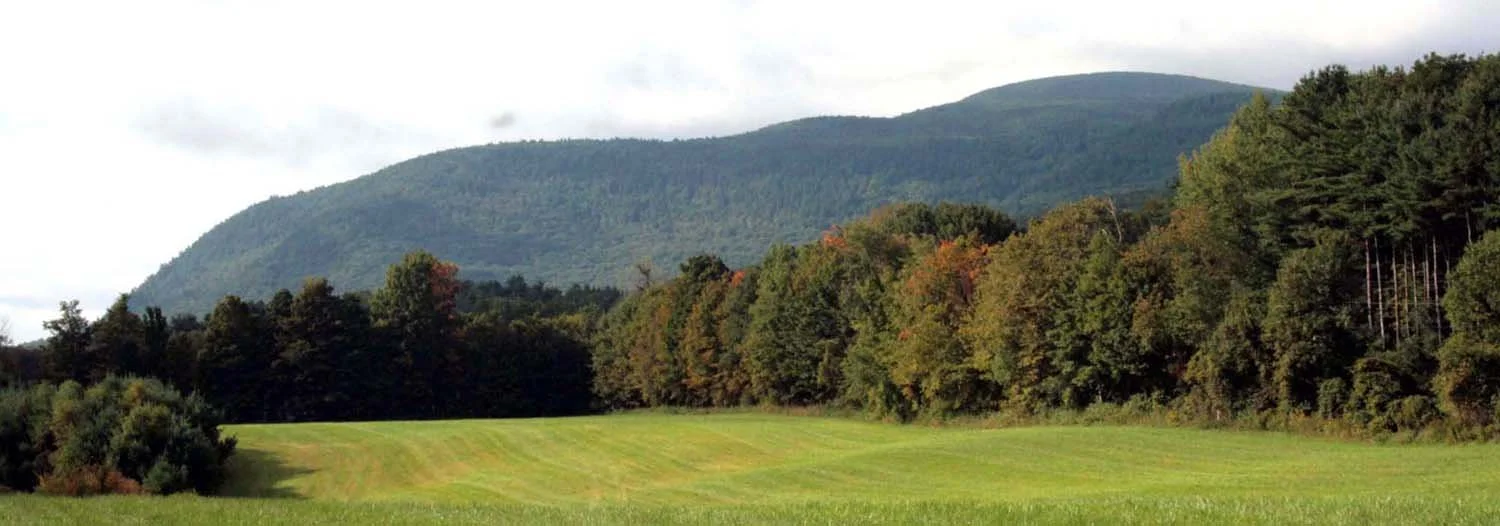
HOW DOES SLT CONSERVE LAND?
Conservation Restrictions: These let owners sell or donate development rights to the Land Trust, giving people a way to protect the land they love while keeping it in the family.
Agricultural Preservation Restrictions: These let landholders sell or donate development rights to the State or Land Trust, giving owners of agricultural land a way to realize the value of their land without having to sell it while ensuring the land’s continued use for farming.
Ownership: A family can sell or donate its land to the Land Trust for conservation.
To ensure that we build a solid legacy of protected farms and natural lands in Sheffield, the Sheffield Land Trust (SLT) strives to be rigorous in its attention to each detail of the land conservation process, and to be courteous, clear and accessible to landowners, to the people of the town of Sheffield, to its officials, and to land conservation partners.
SLT pursues a strategic pattern of conservation throughout the town of Sheffield based on the principles of protecting land that is ecologically, agriculturally, or scenically significant. During its first decades much of SLT's work has focused on the Housatonic River flood plain, June mountain, the Schenob Brook Area of Critical Environmental Concern (ACEC), the Sheffield-Egremont Corridor, and on agricultural lands throughout Sheffield.
When discussing a new land protection opportunity, in addition to the principles listed above, SLT considers such questions as:
-- What are the conservation values of the property (i.e. agricultural, ecological, scenic, historical) and what are the benefits and risks to those values of protecting it or not protecting it?
-- What are the benefits and risks to SLT of protecting or not protecting the property? Issues to consider include: financial (i.e. fundraising capacity and effect on other projects, stewardship costs), legal, community relations, and likelihood of success.
-- How does the property relate to other conserved land in a larger landscape context?
-- What is the most appropriate role for SLT in this project?
-- What is the best and most cost-effective method to use?
Protection Methods
The appropriate protection method for each property emerges from a broad discussion of the above issues as well as the specific circumstances of the proposed project, qualities of the land and the wishes of its current owner.
SLT's preferred methods of conservation are to act as a facilitator in a transaction leading to conservation by other group(s) and the use of conservation restrictions (CR) and agricultural preservation restrictions (APR), but the range of conservation strategies that SLT may consider is outlined below.
Facilitator. In partnership with another conservation organization, state agency or the town, SLT may help
a) negotiate a deal;
b) develop a conservation strategy for a property; and/or
c) fund a project.
SLT would hold no interest in or stewardship responsibility for the property.
Partial Interest. SLT acquires a Conservation Restriction (CR), Agricultural Preservation Restriction (APR), or other partial interest in the property. SLT maintains perpetual stewardship responsibility for ensuring compliance with the CR or APR or APR's may also subsequently be then transferred to the State. Recognizing the time and expense involved, unless the property is important habitat or significant agricultural lands or abuts other conservation land, we avoid parcels of less than five acres. SLT always establishes a stewardship endowment.
Where prudent, SLT to co-hold CRs with other conservation organizations where conservation goals overlap, so that in the event of a violation or other problem, the financial resources of both SLT and the other organization will be available to defend the CR.
Temporary Fee Ownership. SLT acquires land as described above with the intent to convey it to a public or private third party for conservation purposes. The property may be conserved by SLT prior to the transfer or by the third party after the transfer.
Fee Ownership. SLT acquires land through purchase, bargain sale, donation, or bequest. SLT maintains perpetual stewardship and management responsibility for this conservation property. (See SLT Stewardship Policy for information on endowments.) SLT may grant agricultural preservation restrictions and conservation restrictions on land it owns in fee to another conservation organization, agency or town.
Limited development. This method may be used in conjunction with one of the other four conservation methods listed above. SLT would sell or facilitate the sale of a portion of the property for appropriate development to help fund the conservation of the majority of the original property and other properties. In its first thirty years, SLT has done one limited development transaction.